

Laws and regulations set the guardrails that influence where, when, and how companies invest. This has a direct impact on the speed and shape of corporate transitions.
Capabilities in tracking corporate transition progress and monitoring climate law and policy have improved significantly in recent years; yet these datasets largely operate in isolation meaning that understanding of how these two aspects interact remains a challenge.
This disconnect means companies, financial institutions, and policymakers lack the necessary evidence of which laws are most effective in accelerating the transition, and which are contributing barriers to action.
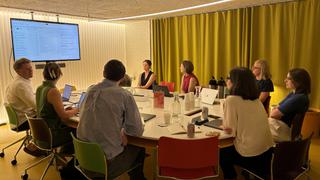
During London Climate Action Week (LCAW) 2026, Arc and software engineering specialist, UPLO, held the inaugural workshop for “ATLAS” (Analysing Transition Laws Across Sectors)—a leading-edge initiative to better understand how a change in law influences corporate investment decisions.
At the core of ATLAS will be an expert-informed AI tool that connects databases on climate law and policy, such as LSE Climate Change Laws of the World and the Oxford Climate Policy Monitor, with corporate transition data from TransitionArc. By connecting legal and policy signals with corporate investment flows, the initiative seeks to make one of the transition’s most important, but least visible, relationships measurable.
Informed by a working group of law and policy, data, and corporate transition experts, Arc and UPLO will create an AI-enabled tool that will allow:
- Corporates to allocate capital where there is a supportive legal and policy landscape, and advocate for policy change where barriers remain;
- Financial institutions to invest with confidence in companies positioned to benefit from legal or policy changes, while identifying potential exposures at risk; and
- Policymakers to better understand the law or policy action they could take that would crowd-in private investment, or where existing regulatory frameworks may be impeding transition action.
Building Phase 1 of ATLAS
Over 2026, the first phase of the ATLAS project will build and test a simplified proof-of-concept that answers three key questions: can legal change be translated into structured economic signals? Can those signals be connected to company investment flows? And do the results reflect real-world investment behaviour?
At the LCAW workshop, the group agreed key methodological and implementation considerations for Phase 1:
- Piloting specific sectors and geographies: The first version of the model will be piloted on the UK Cement sector and Steel sectors in Australia and Japan. These highly concentrated sectors, where a handful of firms dominate, provide an appropriate testing environment for the team to verify the methodology and outputs.
- Identifying law data inputs: The model will incorporate laws that materially impact the cost of doing business, such as taxes, subsidies, levies, prohibitions, as well as laws more likely to change in the near future. Translating legislation into structured data will then allow the model to allocate laws across the value chain segments they impact.
- Building a robust methodology: The model will be built on transparent, granular methodologies reviewed and agreed by the working group of experts. This will ground the model in existing and available research and evidence, avoiding black box approaches that cannot be traced.
- Engaging the ecosystem: In addition to the expertise in the working group, it was agreed that Arc and UPLO would engage with industry representatives and potential users of these outputs during the build of the model, to gather widespread feedback on the approach and outputs.
- Retrospective testing and validation against real-world outcomes: A crucial step in validating the model’s predictive capability will be to test it against past law changes, comparing the estimated impact on investment flows against the actual real-world impacts that followed.
By connecting legal
and policy signals with corporate investment flows, the ATLAS initiative seeks to make one of the transition’s most important, but least visible, relationships measurable.
Tackling challenges and limitations
A recurring theme raised throughout the workshop was how to build something both ambitious and achievable within an incredibly complex space.
Companies are subject to numerous overlapping laws and regulations and often operate across multiple legal jurisdictions. No single act governs an entire sector, and there are factors beyond laws that affect a company’s capital decisions, including cost of materials, distance from sourcing locations, and market demand. Changes in these factors can have spillover effects, feedback loops, and unintended consequences that are near-impossible to track.
This complexity is why understanding the relationship between law and investment has historically been so difficult.
Here, AI can add significant value. The model built under ATLAS will allow for a reading of the entire fabric of a law, mapping laws across value chains, overlaying these to company operations, and showing how these impact economic value creation at the activity level. And it will have the ability to do this continuously and at scale—something that would be impossible to replicate manually.
However, AI is only one part of the solution. Expert review and transparent methodologies are central to the model’s development to ensure outputs are robust, explainable, and grounded in evidence. Recognising these complexities, the working group acknowledged the need to take a streamlined approach in this first phase that can be built on in future iterations.
What’s next?
This workshop is an important first step in enhancing the data connectivity between two fundamental drivers of the transition—law and investment.
More broadly, ATLAS reflects Arc’s mission to connect fragmented sources of information that, together, can provide better evidence for real-world transition decisions. By linking legal and policy developments with company-level transition data, the initiative aims to generate forward-looking insights that help decision makers better understand how legal changes shape corporate transition outcomes.
Phase 1 of ATLAS is focused on building and exploring what’s possible in the current prototype, acknowledging the considerations outlined above.
The working group will continue to discuss and refine the methodology, test outputs and incorporate stakeholder feedback as development progresses over the rest of the year. First results are expected to be shared around the UN Climate Change Conference (COP31) in November and stakeholder feedback will inform the direction for Phase 2 of the project starting in 2027.
If successful, ATLAS has the potential to provide a shared evidence base for understanding which legal interventions most effectively unlock private investment and accelerate corporate transitions.
Interested in collaborating?
If you think this work could be relevant to your area and are interested in helping us shape it, get in touch with our team at info@arcconnect.global.