
- The capital gap: Exposure data alone does not drive capital allocation. Financial decision makers require quantified impacts on cash flow, credit, and asset valuation.
- Resilience intelligence defined: Decision-useful data linking physical hazards and asset vulnerability to financial outcomes and adaptation effectiveness.
- Systemic dependencies: Individual corporate adaptation fails if shared supply chains, local infrastructure, and surrounding ecosystems remain vulnerable.
Extreme weather events and chronic environmental shifts are accelerating, posing immediate and systemic threats to operational continuity and financial performance across sectors and geographies. [i] They expose not only vulnerabilities within the global economy, but also its fundamental reliance on natural ecosystems and on people, whose lives and livelihoods are increasingly threatened by the climate crisis.
As physical climate impacts increase in scale and severity, their relevance is moving to the top of business agendas. Companies and investors increasingly recognise that understanding and managing physical climate risks is an economic imperative. Yet translating physical risks into practical business decisions remains a challenge, and corporate practices for managing these risks are still uneven.
The challenges of understanding physical asset-level climate risk
The economic case for adaptation and resilience is strong in aggregate. Studies indicate that investments in adaptation and resilience can generate benefits substantially greater than its costs when factoring in avoided losses and wider economic and social benefits, from job protection to ecosystem preservation and community security.
For businesses, the investment challenge is not that resilience lacks value. It is that the company-level financial case is often difficult to quantify and remains poorly reflected in capital allocation and risk management processes. This is due to several reasons.
First, companies need to understand where they are exposed and vulnerable, including across their operations, supply chains, and wider dependencies. This requires asset-level insight into hazards, the vulnerability of assets and systems, and the effectiveness of existing adaptation measures.
Second, companies need to translate physical risks and potential resilience measures into financial terms that support decisions. This includes assessing how risks and responses may affect cash flow, costs, asset values, insurance conditions and financing, and incorporating these effects into risk management and capital allocation.
Third, where risks depend on shared infrastructure, ecosystems, suppliers or communities, companies may be required to coordinate with other local and regional stakeholders to implement effective responses. Even well-adapted companies will remain exposed if the systems and stakeholders they depend on are not.
To act, companies and investors need a clearer understanding of what effective corporate resilience looks like in practice.
The reporting and supervisory context is also evolving. IFRS S2 (global climate disclosure rules), where adopted by jurisdictions, and Europe's ESRD (European Sustainability Reporting Standards), both establish climate-related disclosure requirements within their respective scopes. Separately, financial supervisors, including the European Central Bank and the Bank of England, are incorporating physical climate risk into supervisory expectations, risk assessment, and stress testing exercises for financial institutions. These developments increase the demand for transparent, decision-useful information.
Companies and financial institutions therefore face the challenge of grappling with these considerations and translating localised, uncertain, and often systemic climate risks into decision-making at both the enterprise and asset levels.
Defining “good” corporate climate resilience
To act, companies and investors need a clearer understanding of what effective corporate resilience looks like in practice. This requires transparent and comparable information on exposure, vulnerability, critical dependencies, governance, adaptation measures and their effectiveness. Decision makers can then identify where physical risks are concentrated, assess how well organisations are positioned to manage them, identify gaps, set targets, and determine which measures should be prioritised.
Without a common basis for assessing preparedness and progress, investors and companies approach resilience from different starting points. As a result, it becomes difficult to scale resilience efforts collectively.[ii]
Connecting analysis of climate risk and business resilience
We define resilience intelligence as decision-useful information that connects physical hazards, asset and system vulnerability, business dependencies, potential financial consequences, management responses, and evidence of those responses’ effectiveness. And it should be accessible in a transparent and comparable way.
This is the thinking behind ResilienceArc, an open tool designed to bring together asset-level physical risk analysis, adaptation disclosures, and resilience benchmarks to provide a more holistic view of how companies are exposed to physical climate risks and how they are preparing to manage them.
Currently in beta, ResilienceArc features assessments of approximately 200 companies across five metrics for asset-level physical risk exposure and adaptation, and asset-only profiles for an additional 3,000+ companies. As a publicly accessible platform, ResilienceArc will broaden the availability of physical risk and adaptation information, particularly for organisations without extensive proprietary data resources.
WBCSD complements asset-level analysis by working with companies to connect physical climate exposure and vulnerability with value chain dependencies, financial implications, and corporate decision processes. Through member engagement, practical guidance and cross-sector collaboration, it helps identify the information companies need to prioritise risks, evaluate resilience measures and integrate them into operational, strategic, and capital allocation decisions.
It also surfaces a wider demand for better visibility into how physical climate shocks can cascade across suppliers, regions, infrastructure systems, and commodities. Many existing assessments focus on direct asset exposure or long-term average impacts, while providing limited insight into the frequency, severity, and financial implications of wider business disruption.

Turning resilience intelligence into investment action
While companies may be at different stages of understanding and managing physical risks, WBCSD’s and Arc’s respective engagements with the private sector, financial institutions, and climate and resilience experts reveal a common set of intelligence needs for investment action.
Companies require information to answer questions such as: Which exposures are material to the business? What losses or cost volatility could plausibly arise? What is the firm’s risk appetite in view of these? Which resilience measures reduce vulnerability, and how might they affect operational continuity, asset values, insurance terms, financing conditions, or strategic optionality? And how can they credibly and transparently demonstrate the value creation and impact of such measures to investors?
At the same time, investors need to understand whether those exposures are business-critical. Are exposed assets, suppliers, or markets vulnerable? How could those risks impact key financial metrics, and what actions is management taking in response?
In some cases, the business case may be more localised to a company through avoided losses, reduced downtime, improved insurability, or supply security. In others, the benefits may be distributed across firms, suppliers, insurers, lenders, governments, and communities. This is why it can be harder for any one actor to justify, finance, or govern the response.
Unclear ownership, limited ability to capture the benefits of investment, coordination requirements, and financing conditions or gaps in public policy and infrastructure may constrain corporate action. Better intelligence can make these barriers more visible, but it cannot remove them by itself.
Resilience intelligence should therefore be understood as an enabler of investment and coordination. The value of resilience intelligence will depend on the decisions it supports. Companies and capital providers may draw on related information but will use it for different purposes and require different levels of detail, comparability, and assurance (see Table 1 below).
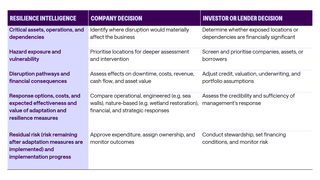
Information should ultimately be aligned with the needs of businesses, their investors, lenders, insurers, regulators, and policymakers. Over time, the objective should be to move from qualitative screening of physical risk and adaptation to decision-useful metrics that support management decisions and, where relevant, investor and lender assessments.
Making resilience investible at scale
Adaptation and resilience measures depend on shared action across the wider system. To support resilience investment at scale, the economy needs stronger links between company action, financing structures, and system-level resilience. That requires shared metrics, interoperable data, and open infrastructure that can bring together different sources of information and connect investors and companies through a common language of resilience.
Arc and WBCSD’s work aims to strengthen these resilience intelligence efforts. And ResilienceArc is just one contribution to this emerging infrastructure. Its purpose is not to replace the growing ecosystem of physical risk data, frameworks, tools and assessments, but to help connect these different dimensions to form a more transparent and comparable view of corporate resilience.
No single organisation has visibility across the full system. We therefore invite investors, companies, data providers, experts, and partners to help shape the next generation of resilience intelligence together. One that is open, collaborative, adaptable to the evolving risk landscape, and capable of supporting better decisions across the entire economy.
Partner with Arc and WBCSD
We are convening engaged companies to explore approaches and uses cases for resilience intelligence.
About WBCSD
The World Business Council for Sustainable Development (WBCSD) is the leading community of around 230 global businesses making sustainability performance a key driver for competitiveness. Established in 1995, WBCSD is a non-profit member-led organization that connects business leaders through all sectors and major economies, and creates the tools and frameworks to scale collective impact, drive cross-sector innovation, and shape an ambitious, enabling policy agenda. We operate from seven offices worldwide — in Geneva, New York, Chicago, Amsterdam, London, Singapore and Wuhan — enabling collaboration across value chains and geographies. Together with our members, we are rewiring economic and financial systems to support the transition to a net-zero, nature-positive, and inclusive future that creates business value.
About Arc
Arc is a global non-profit organisation that builds the shared pathways needed to turn climate and resilience ambitions into tangible investment flows. We work with local partners and global institutions to build the information infrastructure that connects fragmented transition efforts. We fund and develop missing transition pathways, integrate data and frameworks, surface the evidence needed to unlock business action and policy across the world.
Get involved
If you’re working on your approach to physical climate risk, we’d love to hear from you. Contact the WBCSD team directly to participate in working group use cases.